Once a week or twice?
The classic bodybuilding week gives each muscle its own day. The modern advice is to hit everything at least twice. Both sides tend to argue as if frequency were a growth switch in its own right. The research says it mostly is not: what matters is how much good work a muscle gets across the week, and frequency is the tool for fitting that work in.
What the research shows
When the weekly sets are the same, training a muscle more often adds little or nothing. A 2019 review pooled twenty-five studies and found no meaningful difference in growth between higher and lower frequencies once volume was matched. The largest analysis so far, of sixty-seven studies, reached the same verdict for muscle size, while finding that more frequent practice does help strength.
The individual trials in trained lifters look the same. In one, men did identical weekly sets for each muscle either in a single session or split in half across two. After eight weeks, muscle size and strength had improved by similar amounts in both groups.
Not every study agrees. One trial in well-trained men found that training everything five days a week grew two of the three muscles measured more than a once-a-week split did. So the fair reading is “little or no effect on average”, not “frequency never matters”.
Why twice a week still wins in practice
If frequency is not a growth switch, why does nearly every good program train a muscle at least twice? Because one session can only hold so much useful work for one muscle. Each extra set you pile onto the same muscle on the same day adds a little less than the one before, while the fatigue keeps stacking.
German Volume Training is the famous test case: ten sets of ten on one lift. When researchers compared it with five sets of the same exercises, the ten-set group gained no more muscle and less strength. Past a point, the extra sets in a session were simply not registering.
So a muscle that needs a productive week of work has a packing problem. Squeeze it all into one day and the last sets are worth the least and cost the most. Split it across two or three days and every set lands earlier in a session, where it counts for more.
What Stimuli does with it
Sources
- Schoenfeld BJ, Grgic J, Krieger J (2019). How many times per week should a muscle be trained to maximize muscle hypertrophy? A systematic review and meta-analysis of studies examining the effects of resistance training frequency. Journal of Sports Sciences.
- Pelland JC et al. (2026). The resistance training dose response: meta-regressions exploring the effects of weekly volume and frequency on muscle hypertrophy and strength gains. Sports Medicine.
- Brigatto FA et al. (2019). Effect of resistance training frequency on neuromuscular performance and muscle morphology after 8 weeks in trained men. Journal of Strength and Conditioning Research.
- Zaroni RS et al. (2019). High resistance-training frequency enhances muscle thickness in resistance-trained men. Journal of Strength and Conditioning Research.
- Amirthalingam T et al. (2017). Effects of a modified German volume training program on muscular hypertrophy and strength. Journal of Strength and Conditioning Research.
Keep reading
- 10What to train firstWhat exercise order changes, and what it leaves alone
- 11How long a muscle takes to recoverWhy ready comes days before fresh
- 12Do you need a deload week?What a scheduled easy week does and does not do
- 13How little training keeps your muscleMaintenance, breaks and how fast size comes back
- →All guides16 short guides to training for muscle
Train with science
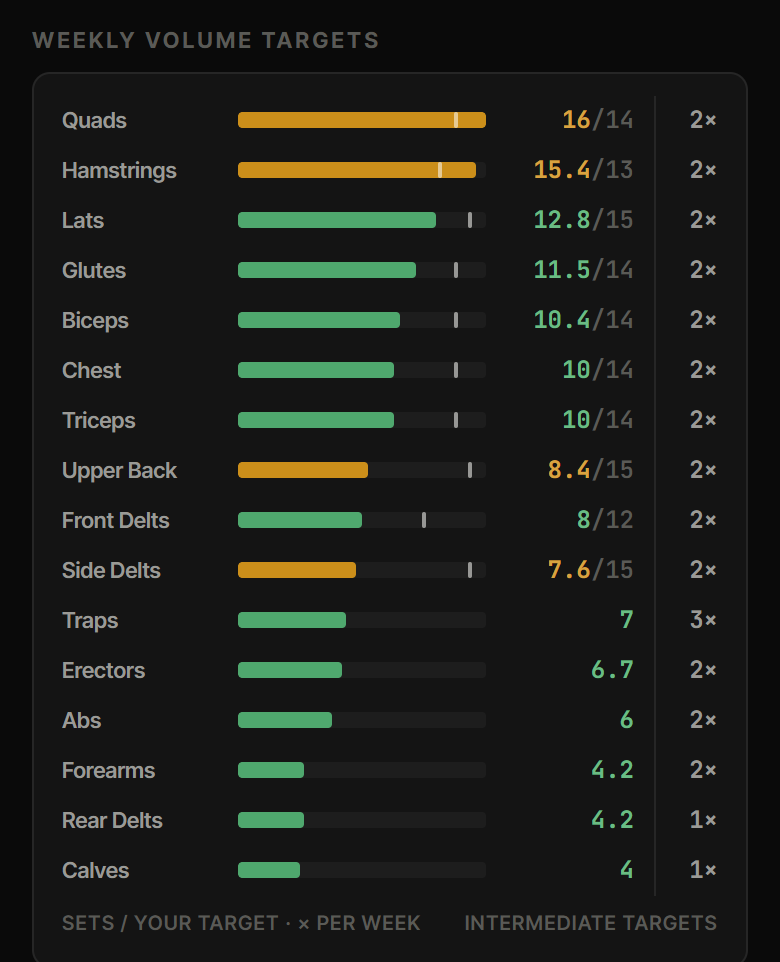
Stimuli gives every muscle an Effective Work score as you log sets, and shows you where it landed.