How long does a muscle need?
“Forty-eight hours” is the standard answer, and like most standard answers it is right on average and wrong for any particular session. How long a muscle needs depends on what you did to it.
What the research shows
Two things stretch recovery more than anything else: how much work you did and how close to failure you took it. When trained men did a long squat session of moderate sets, their jumping power stayed down for two days, and one measure of leg strength was still down after three, the last time anyone checked. When the same men did a session of heavy sets of three, nothing measurable was left after the first half hour.
Closeness to failure works the same way. With the total work held equal, lifters who took their sets to failure were still below normal one to two days later, while those who stopped at half the possible reps had recovered.
The growth signal runs on its own clock. After a hard session, the rate at which a muscle builds new protein has been measured at about double its resting rate a day later and almost back to baseline by a day and a half. That short window is one reason most programs train a muscle more than once a week, although the trials on frequency show the pay-off is smaller than the window suggests.
- 4 hours later+50%
- 24 hours later+109%
- 36 hours later+14%
Chesley et al. (1992), MacDougall et al. (1995)
Soreness tracks none of this well. It is strongest when a movement is new and fades with repetition, even when the training is just as hard. When trained men repeated the same punishing bench press session two weeks later, soreness and strength loss were roughly half what they had been the first time. And in a ten-week study of new lifters, muscle damage was highest in the first week. Only once it had settled did the muscle-building response line up with how much each person actually grew.
Ready is not the same as fresh
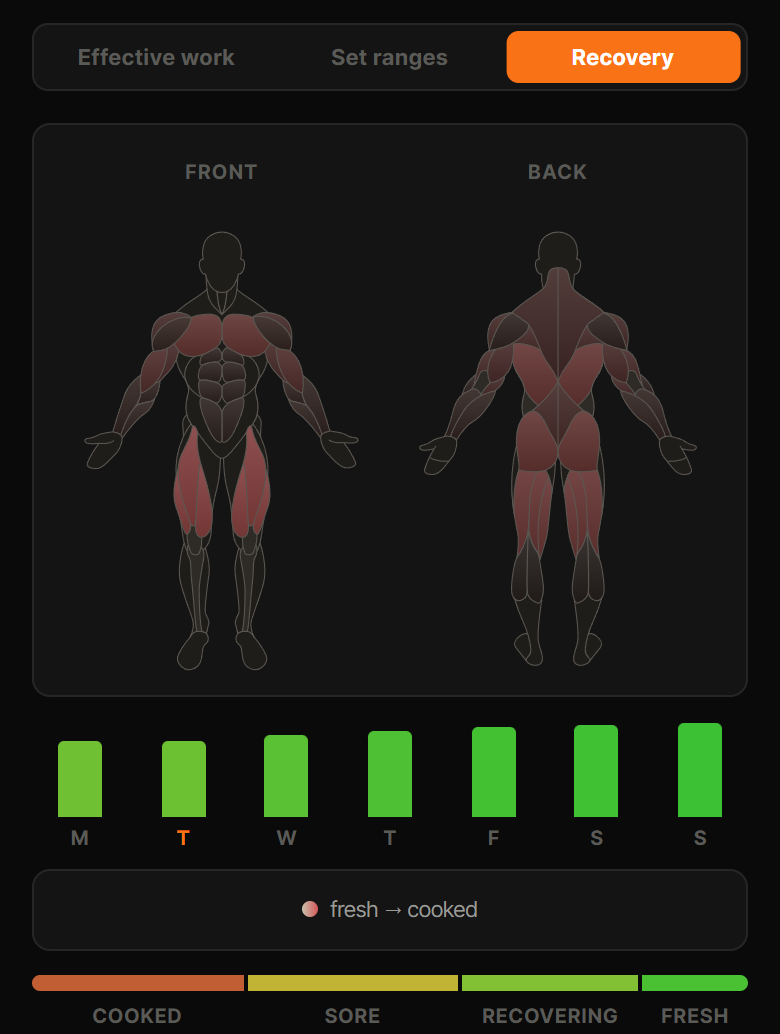
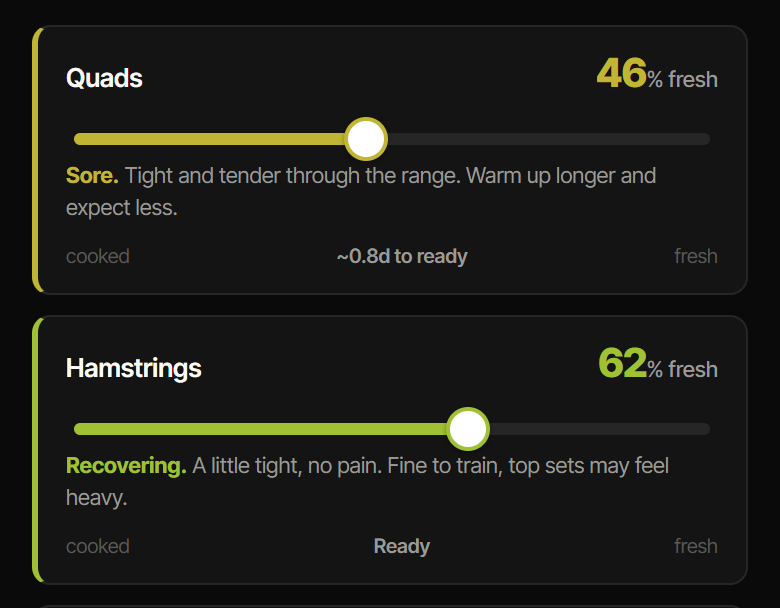
These studies measure two different finish lines. A muscle is ready when it can train productively again. It is fresh when nothing of the last session is left. Ready comes first, often by days, and good programs train on ready: waiting for fresh every time means training each muscle less often than it could handle.
What Stimuli does with it
Sources
- Bartolomei S et al. (2017). Comparison of the recovery response from high-intensity and high-volume resistance exercise in trained men. European Journal of Applied Physiology.
- Morán-Navarro R et al. (2017). Time course of recovery following resistance training leading or not to failure. European Journal of Applied Physiology.
- Chesley A et al. (1992). Changes in human muscle protein synthesis after resistance exercise. Journal of Applied Physiology.
- MacDougall JD et al. (1995). The time course for elevated muscle protein synthesis following heavy resistance exercise. Canadian Journal of Applied Physiology.
- Meneghel AJ et al. (2014). Muscle damage of resistance-trained men after two bouts of eccentric bench press exercise. Journal of Strength and Conditioning Research.
- Damas F et al. (2016). Resistance training-induced changes in integrated myofibrillar protein synthesis are related to hypertrophy only after attenuation of muscle damage. The Journal of Physiology.
Keep reading
- 09How often to train a muscleWhy twice a week is about fitting the work in
- 10What to train firstWhat exercise order changes, and what it leaves alone
- 12Do you need a deload week?What a scheduled easy week does and does not do
- 13How little training keeps your muscleMaintenance, breaks and how fast size comes back
- →All guides16 short guides to training for muscle
Train with science
Stimuli gives every muscle an Effective Work score as you log sets, and shows you where it landed.