How little keeps your muscle?
Holidays, exams, a newborn, a brutal month at work. Sooner or later training gets cut back. The research here is unusually kind: muscle is much cheaper to keep than to build, and what you do lose comes back quickly.
Keeping it takes very little
In the best-known study, adults trained their legs three days a week for four months and then spent the next eight on a fraction of that. The younger adults kept all the muscle they had built on a single session a week, even at a ninth of their earlier weekly work. The older adults were different: they held their strength on the reduced plans but lost the size they had gained.
A shorter trial found the same in young men. After two months of training, one or two reduced sessions a week held both size and strength for a further two months, while stopping altogether lost both.
The condition attached to all of this is the weight on the bar. The maintenance plans that worked cut sessions and sets, not load. A review of the area puts it plainly: the dose can fall a long way as long as the intensity is kept up.
Stopping completely
Even a full break costs less than it feels like. In one trial, new lifters who took ten weeks off in the middle of a program lost size and strength during the break, won them back within the first few weeks of retraining and finished level with a group that had done the same twenty weeks of training without a gap.
Short breaks barely register. A three-week break in the middle of a fifteen-week bench press program caused no significant loss, and the final gains matched those of lifters who trained straight through.
Part of the reason seems to be that muscle remembers. In a small study, men who trained for seven weeks, stopped for seven and trained again gained more lean mass the second time than the first.
- After seven weeks of training+6.5%
- After seven weeks off+1.8%
- After seven weeks back in training+12.4%
Seaborne et al. (2018), the middle bar worked out from the reported averages
A caution: nearly all of these studies used people who were new to lifting, and several were small. They agree with each other, which counts for something. An experienced lifter with years of muscle to keep has been studied far less.
What Stimuli does with it
Sources
- Bickel CS, Cross JM, Bamman MM (2011). Exercise dosing to retain resistance training adaptations in young and older adults. Medicine and Science in Sports and Exercise.
- Tavares LD et al. (2017). Effects of different strength training frequencies during reduced training period on strength and muscle cross-sectional area. European Journal of Sport Science.
- Spiering BA et al. (2021). Maintaining physical performance: the minimal dose of exercise needed to preserve endurance and strength over time. Journal of Strength and Conditioning Research.
- Halonen EJ et al. (2024). Does taking a break matter: adaptations in muscle strength and size between continuous and periodic resistance training. Scandinavian Journal of Medicine and Science in Sports.
- Ogasawara R et al. (2011). Effects of periodic and continued resistance training on muscle CSA and strength in previously untrained men. Clinical Physiology and Functional Imaging.
- Seaborne RA et al. (2018). Human skeletal muscle possesses an epigenetic memory of hypertrophy. Scientific Reports.
Keep reading
- 09How often to train a muscleWhy twice a week is about fitting the work in
- 10What to train firstWhat exercise order changes, and what it leaves alone
- 11How long a muscle takes to recoverWhy ready comes days before fresh
- 12Do you need a deload week?What a scheduled easy week does and does not do
- →All guides16 short guides to training for muscle
Train with science
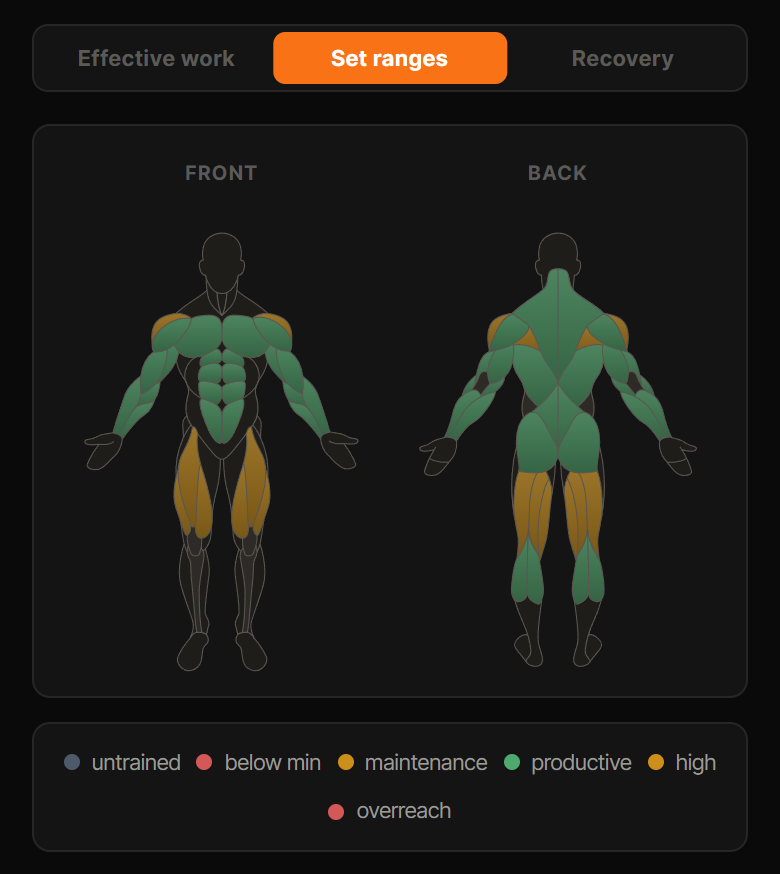
Stimuli gives every muscle an Effective Work score as you log sets, and shows you where it landed.