What is training volume?
Training volume is how much work each muscle gets across a week, counted in sets. Alongside effort, it’s the biggest lever you have for growth, which makes how you count those sets worth getting right.
Most apps treat a set as one whole unit: one set, counted once for your body as a whole. Stimuli doesn’t, because that’s not how your muscles experience it.
Take a set of bench press. Your chest does most of the work, while your shoulders and triceps assist. Counting it as a full set for all three would overstate what your shoulders and triceps actually got. Stimuli splits the work instead, and that’s what lets it tell you what each muscle really received, not just how many sets you did.
How a set gets shared
Every lift you log with weight and reps is shared out across the muscles it trains: the biggest share to the muscle driving the movement, smaller shares to the ones helping out. On a deadlift, your hamstrings, glutes and lower back take the lion’s share, while your forearms get only a sliver.
So a single set rarely counts as one whole set for everything. It’s divided up by who actually did the work, which is both more honest and more useful.
Your weekly volume is the shares, added up
A muscle’s weekly volume is simply all of those shares across the week, totalled. A few exercises where it’s the main mover, plus the assisting shares from everything else, combine into one number.
That total, not a raw count of how many sets you did, is what Stimuli compares against the range that works best for each muscle. It builds as the week goes on, so a mid-week reading is meant to look low: judge your zones at the end of the week, not the middle of it.
Set ranges: the five zones
Each muscle has a weekly range that works best: enough to grow, not so much that you can’t recover. Stimuli sorts where each muscle lands into five zones. (The diagram shows an example lifter sitting in the productive zone; your live reading for every muscle is on the Week tab.)
One more colour you’ll see on the map: a muscle with no logged work that week shows grey (untrained) rather than being placed in a zone.
Why the range shifts as you progress
The right amount of work isn’t fixed. Newer lifters grow on relatively little; more experienced lifters usually need more to keep making progress. Smaller supporting muscles don’t need a target at all: they just shouldn’t be overworked, so Stimuli only ever flags them when they go too far, and anything under that reads as productive.
Stimuli scales each major muscle’s range to your experience, so “productive” always means productive for you, not for some generic average.
Why a focused few sets per exercise
Stimuli keeps each exercise to a small number of working sets. Each extra set on the same movement adds a little less growth while the fatigue cost keeps stacking, so past a point the trade stops being worth it. You’re usually better off spreading the work across different angles.
A short, deliberate set count is also the dial Stimuli uses to land each muscle right inside its productive zone, without tipping it over.
How Stimuli uses all this
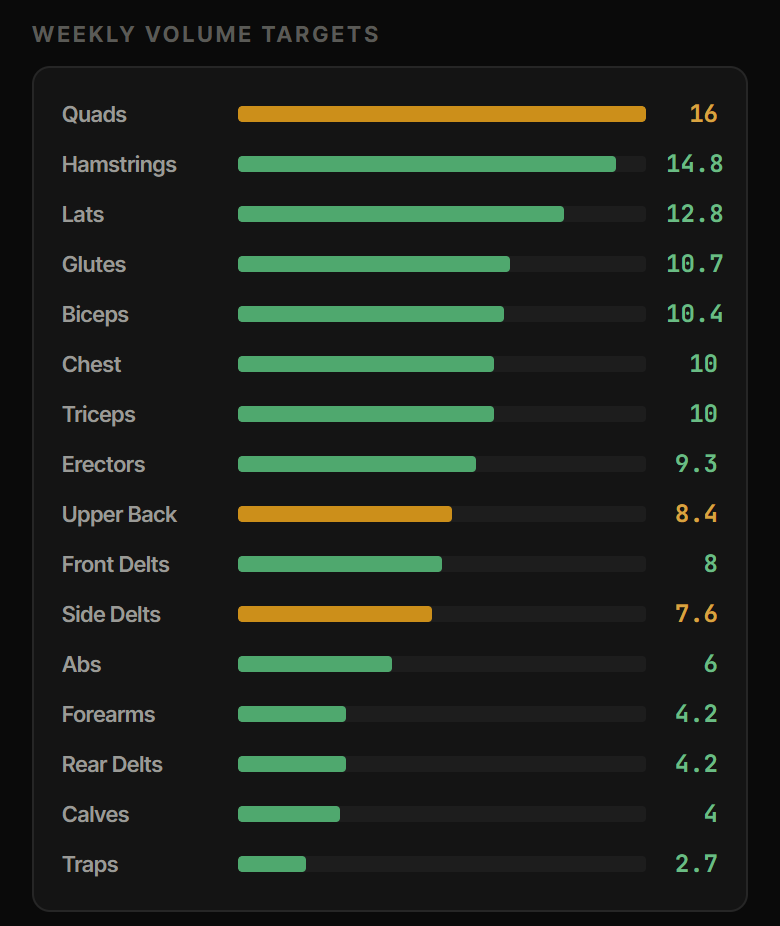
When Stimuli builds or adjusts your program, it adds up every muscle’s shares for the week, makes sure the muscles you’re prioritising land in their productive zone, and never pushes any muscle past what it can recover from.
It’s the same picture you see under Set ranges on your Week tab, so your plan and your feedback always tell the same story.
Train with intent
Stimuli plans each muscle’s week, then scores every set you log against it.