Do you need a deload week?
A deload is a planned easy stretch: fewer sets, lighter weights or both. Asked how they use them, coaches typically describe five to seven days every four to six weeks. The idea makes sense: fatigue builds, so clear it. But the evidence that a scheduled deload helps you grow is thinner than its popularity suggests.
What the research shows
The most direct test so far put trained lifters on the same nine-week program, with one group taking the fifth week off completely. Muscle growth was the same in both groups. Strength came out modestly better in the group that never stopped.
Longer breaks tell a similar story from the other side. In a small six-month bench press study, one group trained straight through while the other took three weeks off after every six weeks of training. Both ended with similar gains in muscle and strength, although the second group had trained for a quarter fewer weeks.
Put together, time off costs less than you would fear and a scheduled break gains less than you would hope. When a panel of coaches was asked to agree on how deloading should be done, one of the statements they agreed on was that scientific understanding of it is limited.
When easing off does help
When fatigue has genuinely outrun recovery. The sign sports medicine uses to define that state is not soreness or mood. It is performance: a drop in what you can do that takes days or weeks of easier training to come back. No blood test or single marker can stand in for it.
A plateau is not that sign. A lift that has stopped going up is flat, not falling, and the usual fix for flat is better sets or a little more work.
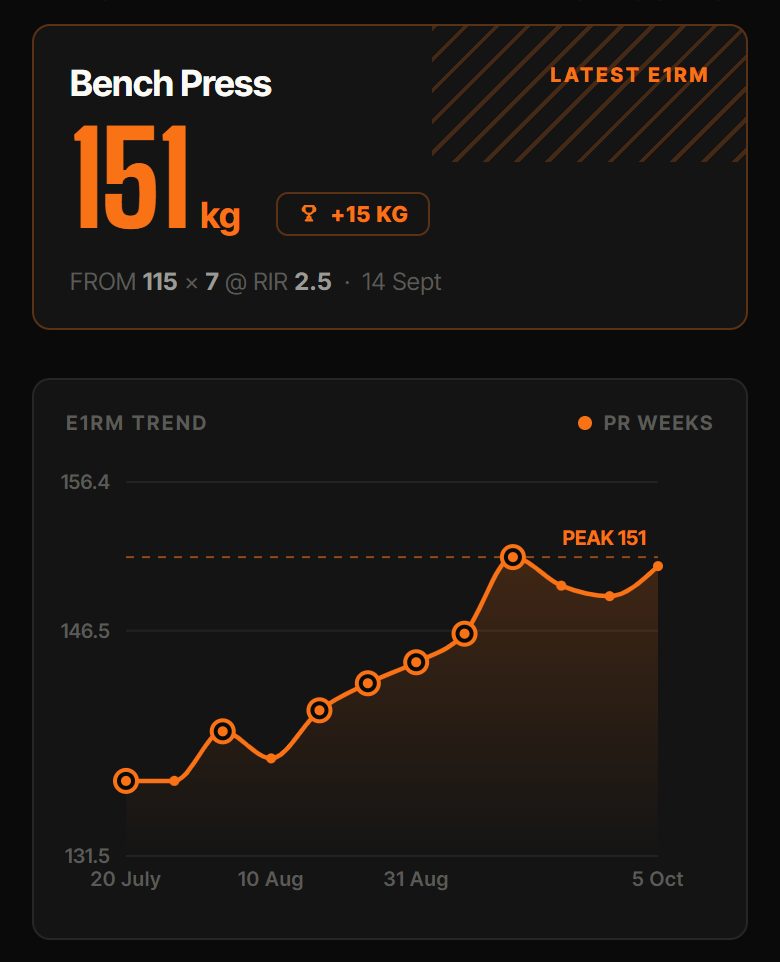
What Stimuli does with it
Sources
- Coleman M et al. (2024). Gaining more from doing less? The effects of a one-week deload period during supervised resistance training on muscular adaptations. PeerJ.
- Ogasawara R et al. (2013). Comparison of muscle hypertrophy following 6-month of continuous and periodic strength training. European Journal of Applied Physiology.
- Bell L et al. (2022). “You can’t shoot another bullet until you’ve reloaded the gun”: coaches’ perceptions, practices and experiences of deloading in strength and physique sports. Frontiers in Sports and Active Living.
- Bell L et al. (2023). Integrating deloading into strength and physique sports training programmes: an international Delphi consensus approach. Sports Medicine - Open.
- Meeusen R et al. (2013). Prevention, diagnosis, and treatment of the overtraining syndrome: joint consensus statement of the European College of Sport Science and the American College of Sports Medicine. Medicine and Science in Sports and Exercise.
Keep reading
- 09How often to train a muscleWhy twice a week is about fitting the work in
- 10What to train firstWhat exercise order changes, and what it leaves alone
- 11How long a muscle takes to recoverWhy ready comes days before fresh
- 13How little training keeps your muscleMaintenance, breaks and how fast size comes back
- →All guides16 short guides to training for muscle
Train with science
Stimuli gives every muscle an Effective Work score as you log sets, and shows you where it landed.