Why the stretch matters
Two exercises can train the same muscle with the same effort and still grow it differently. One of the clearest findings of recent years is what often separates them: whether the muscle is worked hard while it is long.
What the research shows
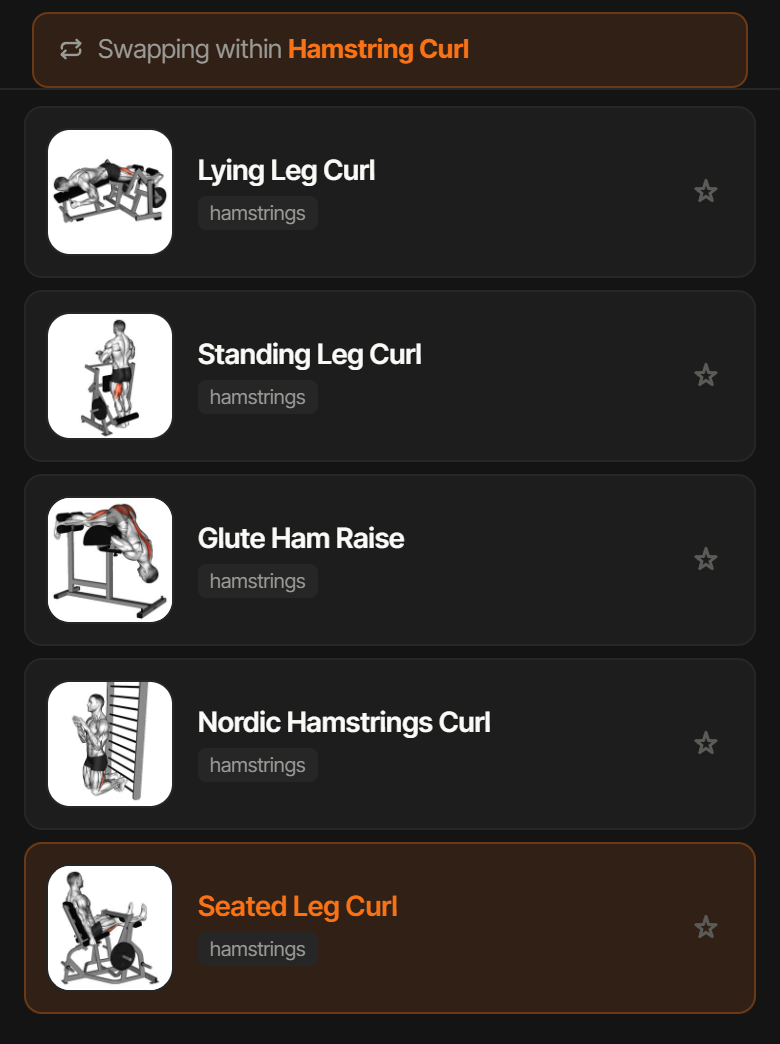
The cleanest tests take one muscle and two versions of the same movement. The hamstrings cross the hip, so sitting upright lengthens them. In a twelve-week trial, each person trained one leg with seated leg curls and the other with lying leg curls. The seated side grew about half as much again.
The long head of the triceps crosses the shoulder, so raising the arm overhead lengthens it. Twelve weeks of cable extensions done overhead grew the long head about one and a half times as much as the same extensions done with the arm by the side, and the rest of the triceps grew more as well.
The gastrocnemius, the large calf muscle, crosses the knee, so a straight leg lengthens it. Standing calf raises grew it substantially. Seated raises, with the knee bent, barely grew it at all, while the deeper soleus grew the same either way.
- Seated leg curl+14%
- Lying leg curl+9%
- Overhead extension+28.5%
- Arm by the side+19.6%
- Standing calf raise+12.4%
- Seated calf raise+1.7%
Maeo et al. (2021, 2023), Kinoshita et al. (2023)
The same pattern appears inside a single exercise. When people train only half of a movement, the half where the muscle is long tends to match or beat the full range, and the half where it is short tends to do worst.
A caution on the size of the effect: the three comparison studies come from one laboratory and used small groups. The direction is consistent across them. The exact numbers will move as more studies arrive.
What it does not mean
It does not mean short-position exercises are wasted. Hip thrusts are hardest at lockout, where the glutes are shortest, and in a nine-week comparison in new lifters they grew the glutes as well as squats did.
And it is not a reason to cut reps short. In trained lifters, reps done only in the stretched half and reps done through the full range grew the arms equally over eight weeks. The benefit comes from including the stretch under load, which a full, controlled rep already does.
What Stimuli does with it
Sources
- Maeo S et al. (2021). Greater hamstrings muscle hypertrophy but similar damage protection after training at long versus short muscle lengths. Medicine and Science in Sports and Exercise.
- Maeo S et al. (2023). Triceps brachii hypertrophy is substantially greater after elbow extension training performed in the overhead versus neutral arm position. European Journal of Sport Science.
- Kinoshita M et al. (2023). Triceps surae muscle hypertrophy is greater after standing versus seated calf-raise training. Frontiers in Physiology.
- Pedrosa GF et al. (2022). Partial range of motion training elicits favorable improvements in muscular adaptations when carried out at long muscle lengths. European Journal of Sport Science.
- Kassiano W et al. (2023). Greater gastrocnemius muscle hypertrophy after partial range of motion training performed at long muscle lengths. Journal of Strength and Conditioning Research.
- Plotkin DL et al. (2023). Hip thrust and back squat training elicit similar gluteus muscle hypertrophy and transfer similarly to the deadlift. Frontiers in Physiology.
- Wolf M et al. (2025). Lengthened partial repetitions elicit similar muscular adaptations as full range of motion repetitions during resistance training in trained individuals. PeerJ.
Keep reading
- 15What compound lifts missThe muscles the big lifts leave behind
- 16Machines, free weights or bodyweight?What the equipment changes, and what it cannot
- →All guides16 short guides to training for muscle
Train with science
Stimuli gives every muscle an Effective Work score as you log sets, and shows you where it landed.