How good is your guess?
Weight and reps are facts. RIR is a judgement you make in the last second of a set, and Effective Work, your estimated max and your next suggested set are all built on it. So it is worth knowing how good people are at that judgement. The research is specific about where it goes wrong.
People stop sooner than they think
The largest review of the question pooled twelve studies in which lifters predicted how many reps they could do and then did as many as they could. On average they had about one more rep in them than they predicted. The error ran one way: people believed they were closer to failure than they were.
How far out the guess is made matters most. In one study, trained men squatted a moderate weight to failure and called out the moment they believed they had five, three and one reps left. At five they were out by about five reps. At three, by more than three. Even at one they were out by about two.
- Called five reps left5.2 reps
- Called three reps left3.7 reps
- Called one rep left2.1 reps
Zourdos et al. (2021)
Shorter, heavier sets are easier to read. The same review found predictions were more accurate in sets of twelve reps or fewer than in longer ones, and on a fairly heavy bench press, trained men and women called their RIR to within about a rep.
Experience does not rescue you. One study of gym members saw a tendency for experienced lifters to do better when they predicted before the set began. The pooled evidence, and the studies that asked during the set, found no such advantage. This is a skill you calibrate on purpose, not one that arrives with years.
Why it matters here
An RIR logged too low flatters every number. A set you call RIR 1 that really had four reps left is scored as hard work it was not, and your next suggestion is built on strength you have not shown. An honest RIR is what makes those numbers mean something.
How to calibrate
What Stimuli does with it
You log RIR after every set, in half-steps, because near failure half a rep is a real difference. If you think in RPE, change the Effort scale in Settings, under Workout defaults: Stimuli treats the two as the same information.
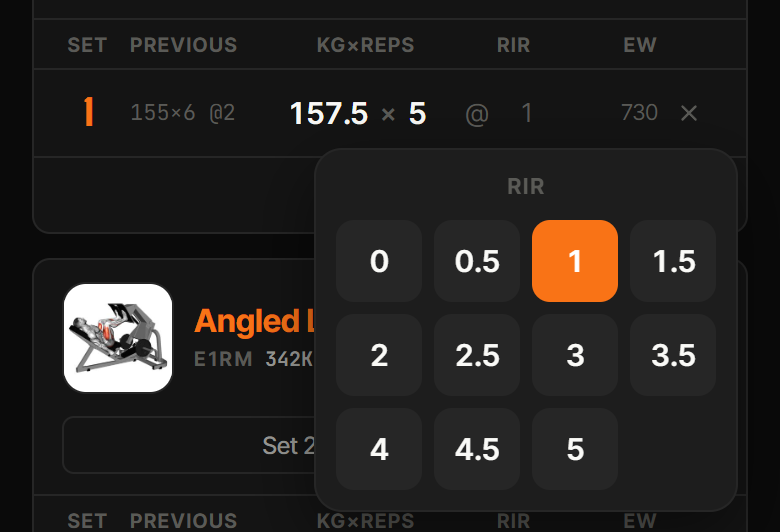
Stimuli takes the number you give it at face value. It cannot see the bar, which is why the check has to be yours.
Sources
- Halperin I et al. (2022). Accuracy in predicting repetitions to task failure in resistance exercise: a scoping review and exploratory meta-analysis. Sports Medicine.
- Zourdos MC et al. (2021). Proximity to failure and total repetitions performed in a set influences accuracy of intraset repetitions in reserve-based rating of perceived exertion. Journal of Strength and Conditioning Research.
- Refalo MC et al. (2024). Accuracy of intraset repetitions-in-reserve predictions during the bench press exercise in resistance-trained male and female subjects. Journal of Strength and Conditioning Research.
- Steele J et al. (2017). Ability to predict repetitions to momentary failure is not perfectly accurate, though improves with resistance training experience. PeerJ.
- Morán-Navarro R et al. (2019). Movement velocity as a measure of level of effort during resistance exercise. Journal of Strength and Conditioning Research.
Keep reading
- 04Do you need to train to failure?What a rep or two in reserve gives up, and what it saves
- →All guides16 short guides to training for muscle
Train with science
Stimuli gives every muscle an Effective Work score as you log sets, and shows you where it landed.