How long should you rest?
Short rests feel productive. You sweat more, the pump comes faster and the session ends sooner. For years that feeling was the case for keeping rests under a minute when training for size. When it was tested, the result went the other way.
What the research shows
In an eight-week trial, trained men followed the same program with either one minute or three minutes between sets. The three-minute group gained more strength on the squat and bench press and more muscle at the front of the thigh.
The likely reason is arithmetic. Rest too little and you cannot repeat your performance. When lifters did four sets of squats and bench presses at a fixed weight, they completed the most total reps with five minutes between sets, fewer with two and the fewest with one. Fewer hard reps at the same weight is less of the thing that drives growth.
A later experiment tested that explanation directly. With one-minute rests the thigh grew about half as much as with three-minute rests. But when the short-rest work was brought up to match the long-rest total, growth matched too, and when the long-rest work was cut down to the short-rest total, its advantage vanished. Short rest was not harmful in itself. It cost work.
- Three-minute rests+13.1%
- One-minute rests+12.9%
- Three-minute rests+6.6%
- One-minute rests+6.8%
Longo et al. (2022)
How long is long enough? Pooling the trials, there is probably a small benefit to resting more than a minute, and no detectable extra growth from resting beyond about a minute and a half. The evidence is thin enough that the honest answer is a floor and not a target: rest at least a minute, then as long as it takes to repeat your reps. Big compound lifts usually take longer than small ones.
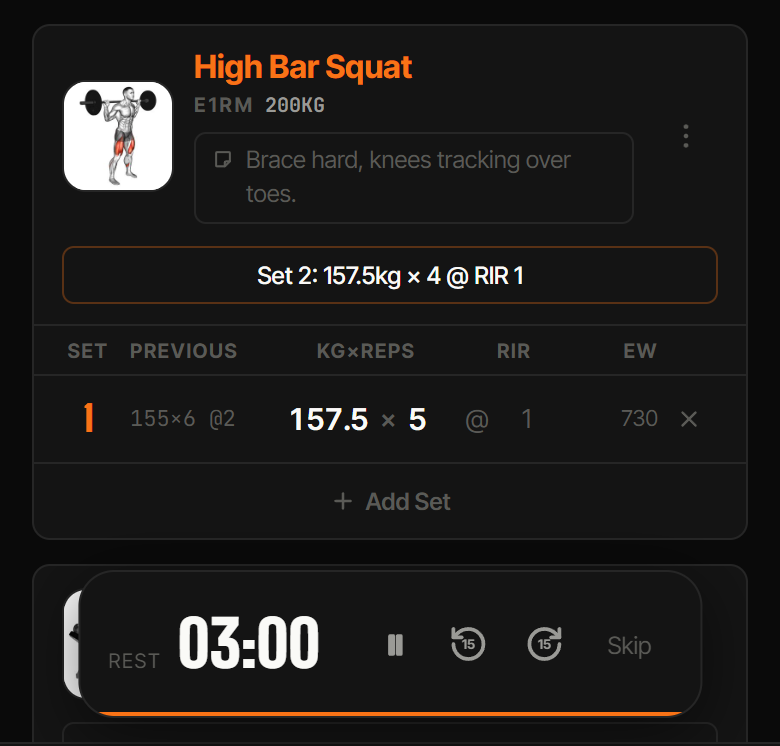
What Stimuli does with it
Sources
- Schoenfeld BJ et al. (2016). Longer interset rest periods enhance muscle strength and hypertrophy in resistance-trained men. Journal of Strength and Conditioning Research.
- Willardson JM, Burkett LN (2005). A comparison of 3 different rest intervals on the exercise volume completed during a workout. Journal of Strength and Conditioning Research.
- Longo AR et al. (2022). Volume load rather than resting interval influences muscle hypertrophy during high-intensity resistance training. Journal of Strength and Conditioning Research.
- Singer A et al. (2024). Give it a rest: a systematic review with Bayesian meta-analysis on the effect of inter-set rest interval duration on muscle hypertrophy. Frontiers in Sports and Active Living.
Keep reading
- 07Heavy weights or light weights?What the rep count changes, and what it does not
- 08When to add weightLoad or reps, and how your next set is chosen
- →All guides16 short guides to training for muscle
Train with science
Stimuli gives every muscle an Effective Work score as you log sets, and shows you where it landed.